The Paper Trail of Desperation
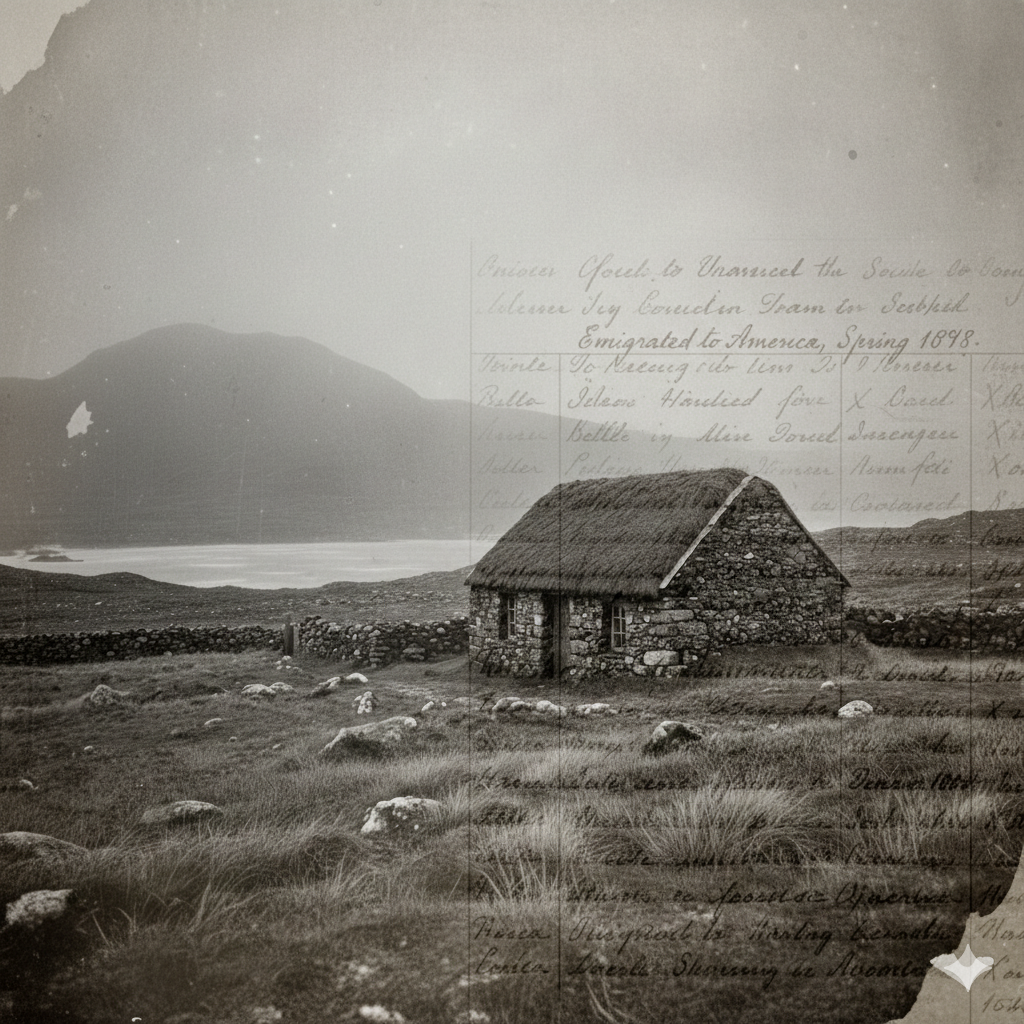
In 1847, a Connemara laborer named Patrick Joyce borrowed £2 to buy seed potatoes. The loan document survives in The National Archives series T 91/88. What genealogists miss is that this wasn’t charity—it was a financial contract charging 14.9% annual interest, requiring two neighbors to pledge their homes as collateral, and demanding weekly repayments of 2 shillings during the worst subsistence crisis in Irish history.
Joyce defaulted within six weeks. The guarantors—Michael Faherty and Thomas King—were then liable for the full debt. All three names appear in the subsequent Petty Sessions court records for Clifden, with asset seizures documented in the “Returns to the Clerk of the Peace” (T 91/144). Faherty’s entry ends with a notation: “Emigrated to America, March 1848.”
This is the archival landscape most genealogists never access. They search for ancestors in church registers and land valuations, but the landless poor—those without leases, without property, without formal marriages recorded in Protestant registers—exist primarily in the administrative debris of debt collection.
The Myth: Famine relief was humanitarian aid distributed freely to the starving.
The Reality: The Reproductive Loan Fund system was microfinance capitalism applied to crisis conditions. It created an interlocking web of financial liability that destroyed family networks and accelerated emigration.
What the Reproductive Loan Funds Actually Were
The Irish Reproductive Loan Fund system operated from 1823 to 1848 under Parliamentary supervision. The term “reproductive” meant the capital was supposed to regenerate through interest and repayment—making it self-sustaining. Local committees, staffed by landed gentry, clergy, and merchants, distributed small loans (typically £2–£10) to laborers for tools, livestock, or seed.
The Clifden district fund operated from 1842 to 1849. Its records survive in TNA series T 91/86–92, comprising:
- T 91/86–91: Account books showing loan disbursements, repayment schedules, and interest calculations
- T 91/92: “List of Applicants”—the census of desperation, containing names, townlands, occupation, loan amount, and purpose
- T 91/101–102 (Oughterard extension): “Security Note Books”—the guarantor ledgers showing who pledged for whom
These aren’t abstracts. These are line-by-line financial autopsies.
The Interest Rate Reality
The fund charged between 7.5% and 14.9% annual interest depending on the perceived risk of the borrower. A £2 loan required repayment of £2 5s over one year—paid in weekly installments of 10.5 pence.
Context: In 1847, a day laborer in Connemara earned approximately 8 pence per day during harvest season—if work was available. During the winter months, there was no wage labor. The potato crop had failed for the second consecutive year. The loan system didn’t provide relief; it extracted the last financial resources from families already on the edge of biological survival.
GOLD DUST: The Guarantor Blood Bond
Every loan required two sureties—neighbors or relatives who pledged to cover the debt if the borrower defaulted. This created a cascading liability structure. When one family fell, two more were pulled into the financial vortex. The guarantor lists in T 91/101–102 are genealogical dynamite: they reveal kinship networks, neighborhood clusters, and the social architecture of pre-Famine townlands. If you can’t find your ancestor in the primary borrower list, search the guarantor columns. The same surnames repeat across dozens of transactions, revealing which families held sufficient status to pledge—and which were too poor even to guarantee.
The Gatekeepers: Who Decided

The Clifden Reproductive Loan Fund Committee was not a democratic institution. The board members were:
| Name | Position | Significance |
|---|---|---|
| Hyacinth D’Arcy | Landed proprietor | Owned 44,000 acres in Connemara; his signature approved or denied every loan |
| Rev. William Henry | Church of Ireland Rector | Controlled “moral character” assessments; his refusal ended applications |
| James D’Arcy | Land agent | Enforced repayments; coordinated with Petty Sessions for asset seizure |
| Richard Martin | Merchant, Clifden | Supplied goods purchased with loan funds; profited from both lending and retail |
These men didn’t just administer charity. They performed social audits. Their marginal notes in T 91/92—”industrious,” “known drunkard,” “unreliable”—determined who received capital and who was excluded from the last financial lifeline before starvation or emigration.
The loans were political instruments. D’Arcy used them to stabilize tenancies on his estates by preventing total destitution. Rev. Henry used them to encourage conversion to Protestantism—the “taking of the soup” wasn’t limited to food distribution. The documentary evidence is in the correlation between loan approvals and baptismal records at Clifden Church of Ireland parish (NLI microfilm P.4222).
The Hidden Record: Nautical Schools and Fishing Gear Requisitions
Buried in T 91/202 (Galway County Papers, Miscellaneous) is a subseries most researchers never examine: “Nautical Schools and Fishing Gear Requisitions, 1847–1848.”
This was an experimental program launched in response to the mass starvation along the Connemara coast. The theory—advanced by relief officials in Dublin—was that the population could be “transitioned” from subsistence agriculture to commercial fishing. The government established nautical training schools in Clifden and Roundstone, offering loans for fishing boats, nets, and tackle.
The program was a catastrophe. Most Connemara laborers had no maritime experience beyond kelp harvesting. The loans required repayment in cash—but fish prices collapsed in 1848 due to oversupply as desperate families flooded the market. The default rate exceeded 80%.
But for genealogists, T 91/202 is a secret door. The requisition lists include:
- Full names of applicants
- Townland of residence
- Type of vessel or gear requested
- Names of crew members or family partners
- Disposition of the loan (approved, rejected, defaulted)
If your Connemara ancestor’s surname is associated with coastal townlands—Cleggan, Ballynakill, Derryinver, Streamstown—search this record first. You’ll find families who don’t appear in later Griffith’s Valuation because they emigrated before 1855.
Reconstructing Lives: The Archival Forensic Process
Step 1: The Loan Application (T 91/92)
Start with the “List of Applicants.” The entries follow this format:
Name: Michael Conneely
Townland: Ballyconneely
Occupation: Labourer
Loan Amount: £3
Purpose: Purchase of cow
Sureties: Patrick Conneely, John Folan
Approved: Yes
Date: 12 March 1846
This single entry gives you:
- Confirmation of residence in 1846
- Occupation (crucial for landless ancestors)
- Financial capacity (£3 was significant)
- Social network (guarantors)
- Economic strategy (livestock investment)
Step 2: The Repayment Ledger (T 91/86–91)
Track the borrower’s name through the account books. The entries show weekly payments (or absence thereof). Look for marginal annotations:
- “Paid in full”—rare
- “Defaulted, proceedings initiated”—common
- “Emigrated”—the exit sign
- “Deceased”—check corresponding death records
A gap in payments during winter 1846–47 isn’t moral failure—it’s the documentary trace of the first total potato failure.
Step 3: The Guarantor Network (T 91/101–102)
The Security Note Books contain the pledges. Format example:
Borrower: Thomas Joyce
Surety 1: Martin Joyce, Roundstone
Surety 2: Michael McDonagh, Ballynahinch
Property Pledged: “One acre of bog, three sheep”
This tells you:
- Martin Joyce is likely a brother or cousin (same surname, nearby townland)
- Michael McDonagh is a cross-surname connection—check for marriage links
- The property description reveals subsistence-level assets
GOLD DUST: The Exception to the Rule
Standard genealogical advice says “the Irish poor left no records.” The Reproductive Loan Funds prove otherwise. But these records exist because the state wanted to track debt, not because they cared about preserving family histories. The loans weren’t kept to help genealogists—they were kept to enforce repayment and asset seizure. Understanding this transforms your research approach: you’re not looking for your ancestor’s life story. You’re reconstructing the administrative response to their poverty.
Step 4: The Default Cascade (T 91/144 + Petty Sessions)
When repayment failed, the case moved to the Petty Sessions Court. The “Returns to the Clerk of the Peace” (T 91/144) function as a tracking document between the fund and the court system. They note:
- Name of defaulter
- Amount owed
- Court hearing date
- Outcome (“Judgement for plaintiff,” “Seizure of goods,” “No assets found”)
- Final disposition
The phrase “Emigrated to America” or “Went to England” appears frequently in the 1848–1849 entries. This is a proxy passenger list. Cross-reference these names with the Assisted Emigration Registers (available through PRONI for some estates) and the New York arrival records starting in 1846.
For Thomas Joyce from the earlier example, the chain looks like this:
- Loan approved March 1846 (T 91/92)
- Payments cease December 1846 (T 91/88)
- Court proceedings March 1847 (T 91/144)
- Asset seizure (one cow) recorded May 1847
- Guarantor Martin Joyce now liable for remaining £2 10s
- Final notation: “Thomas Joyce, emigrated Boston, September 1847”
That single word—”emigrated”—is the archival endpoint. But it gives you a departure window and destination for further research.
The Impossible Math of 1847

Let’s calculate what a £2 loan meant in practical terms during the Famine’s peak year:
Loan amount: £2
Interest (14.9% annual): 6 shillings
Total repayment: £2 6s
Weekly payment required: 10.5 pence
Laborer’s wage (when available): 8 pence/day
Days of work needed per week to make payment: 1.3 days
Actual days of wage labor available, winter 1847: 0–2 days/week
The arithmetic of survival didn’t work. The fund didn’t fail because borrowers were irresponsible. It failed because microfinance requires stable income to function, and the Famine destroyed income stability.
The broader social impact: when one borrower defaulted, the guarantors were pursued. This fractured community bonds. Families who had pledged for neighbors now faced destitution themselves. The social fabric—the kinship and townland networks that had sustained Irish rural life—was shredded by the guarantor system. Emigration wasn’t just an economic decision; it was an escape from cascading financial liability.
The Maritime Pivot That Failed
The Nautical Schools initiative (documented in T 91/202) deserves reconstruction because it reveals the administrative response to mass starvation—and its spectacular failure.
In 1847, the government allocated £15,000 for maritime training in the west. The theory was elegant: Connemara had abundant fish stocks but lacked commercial fishing infrastructure. If the starving could be trained and equipped, they’d become self-sufficient.
The reality:
- Most applicants had no boats and couldn’t afford them even with loans
- The loan terms required immediate repayment from fish sales
- Fish prices collapsed as oversupply hit markets
- The physical weakness from starvation made the labor impossible
By 1849, the program was abandoned. The loan records show default rates of 82% in Clifden, 79% in Roundstone. But the archival value persists: the applicant lists contain families who vanish from all other records after 1849. They’re not in Griffith’s Valuation. They’re not in later census fragments. But they’re here, with full names, townlands, and family associations.
Research Strategy: If your ancestor’s townland is coastal and you hit a brick wall in the 1850s, check T 91/202. The fishing gear requisitions may be the last Irish document that captures them before emigration.
The Debt Trail as Genealogical Gold
The Reproductive Loan Funds invert the traditional research hierarchy. We’re trained to seek church registers, land records, and wills—the documents of property and legitimacy. But for the landless majority, these records don’t exist. The loan funds catch them at the moment of economic crisis, which—grimly—is when the state paid attention.
This changes your research methodology:
Traditional approach: Search for ancestor → find nothing → assume no records exist
Debt trail approach: Assume crisis generated documentation → search financial and legal records → reconstruct network → find ancestor embedded in guarantor lists, court proceedings, or emigration notations
The guarantor system is particularly powerful because it maps social relationships. If you find your ancestor as a surety for someone else, you’ve identified their trusted network. Follow those guarantors forward into emigration records, later census data, and overseas destinations. The families often emigrated in clusters—the guarantor bonds that trapped them in debt also held them together in migration.
From Clifden to Boston: The Documentary Bridge
T 91/144 (Returns to the Clerk of the Peace) contains the phrase “Emigrated to America” or variations (“Went to England,” “Left for Canada”) in approximately 300 entries between 1847–1849. These aren’t formal passenger lists, but they’re evidence of departure.
Cross-referencing strategy:
- Note the exact spelling of the name and the month/year of the “Emigrated” notation
- Search Massachusetts passenger arrival records (Boston was the primary western Irish destination) for the subsequent 6-month window
- Cross-reference with the Emigrant Savings Bank records (New York) starting in 1850—many Clifden emigrants sent remittances back through this institution
- Check the Toronto and Quebec arrival records for the same period—Canada was often the intermediate destination before secondary migration to the US
The debt record becomes the Irish endpoint. The passenger record becomes the American starting point. Together, they bridge the gap.
Ready to stop guessing and start finding? Join our 12-Week Masterclass to master the advanced strategies of Irish genealogy.
https://ouririshroots.ie/wp-content/uploads/2026/01/Irish-Genealogy-Masterclass.pdf